Showing posts with label Marina. Show all posts

Wednesday, February 6, 2019

6. Puerto Madryn, Argentina

Puerto Madryn


We are almost half way now from Montevideo to Tierra del Fuego, the tip of South America. Puerto Madryn is a small port city at the northern end of Patagonia.
Argentine Sea


The Argentine Sea is one of the world's largest seas, stretching from Rio de la Plata to the Magellan Strait at the tip of South America. It is relatively moderate in temperature. I should know, I swam in it.

Flag of Argentina with the Sun of May


For those of you who are interested in vexillology (a new word for most readers: the study of maps), there is much information available about Argentina's flag. Centred, is the Sun of May: from the Inca sun god, or from the May Revolution in 1810 when Argentina gained its independence from the Spanish Empire?


How does it differ from the Uruguayan flag? They are  similar, yet different. This is all quite vexing. Sorry, I did not shoot the Uruguayan flag. You'll have to find it yourself.


At the Malvinas Heroes Monument
 we respectfully removed our hats.
This we learned to do at the San Martin Mausoleum in Buenos 
Aires
Playa Luis Piedrabuena (aka beach by the pier)

I don't think I got the name of the beach right but that's where I had a quick dip, rather than a swim, because I don't like to swim around ships, especially the older ones that do not have holding tanks for you-know-what ...
Anyway, the water was warm. This is summer in Argentina, after all. 


Today is Christmas Eve. 
From the Marina's daily newspaper we read:

Sunny
High 85F/29C
Sunrise 5:39 am. Sunset 8:54 pm


The latitude is about 42 degrees South. The California/Oregon border is approximately the equivalent latitude in the Northern Hemisphere. I usually do not  swim in the cold Pacific waters of Northern California. Even way south, the LA surfers wear shorty wetsuits. The warm Brazilian current warms these waters of the Argentine Sea. I did not expect to be able to swim in the Atlantic ocean off the coast of northern Patagonia, just 175 km north of the largest Magellan Penguin colony on the continent!


So what do we do on a hot Christmas Eve shore leave in Patagonia? 
Mas Amor Por Favor Dress Shop


Buy my wife a Christmas present. I had been procrastinating again. 


1. An open credit card at the Mas Amor Por Favor (More Love Please) dress shop for little local blonde girls?


or

2. Buy her a whole selection of local Argentinian craft beers?
Antiguas Costumbres 


Beagle Beer

Antares + Two
Antares + Four
Surprise Labels


or

3. Offer her carte blanche at the local wine store for the best Argentinean wine on the shelf?

Descorche Vinoteca

She chose the wine. It was a very special limited Malbec that is not exported. It was our Christmas dinner wine at the  Marina's  French restaurant - JACQUES.


Piattelli is exported, though not this 2017 Reserve, I believe. High elevation vineyards? Don't know much about that but we trust our taste for wine. She has the glass at home now for the pretenders and for the memories.
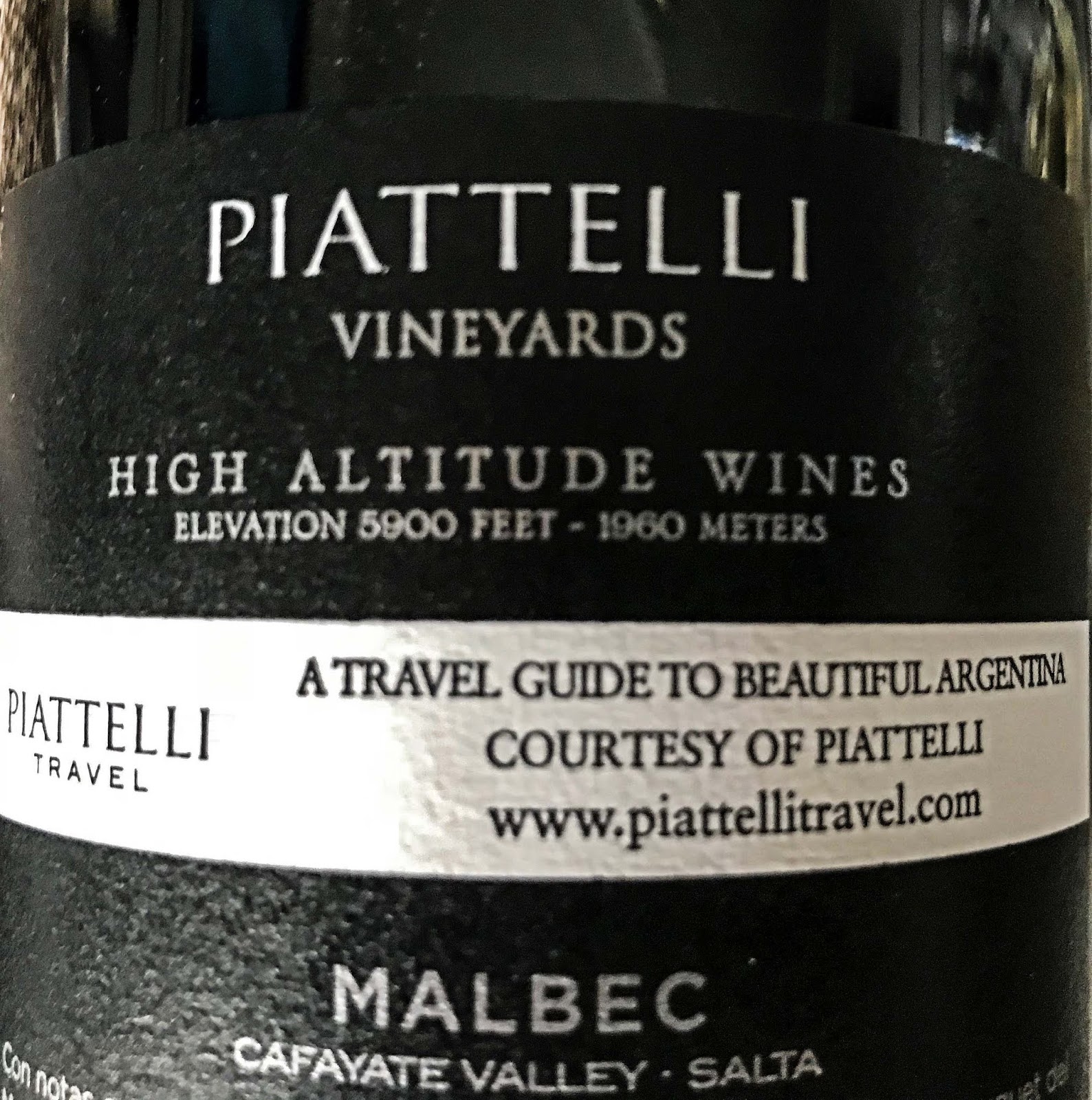


Me? I got fingerless wool gloves for Christmas. A perfect gift for the photographer guy when we got further south into the cold.

Headless photographer. See gloves.


(after 49.5 yrs of marriage who needs bigger gifts? Actually, the cruise was the gift - Christmas and Anniversary)


---------------------------------------------------------
the fingers of Punta del Este


Speaking of fingers, I forgot to place the fingers on the right in the Punta del Este blog posting.


What? Look them up. I'm not going back. Gotta move on.
------------------------------------------------------------------------------


Little did we know that the waters around Puerto Madryn are the breeding grounds for the Southern Right Whale - the "Queen of the Patagonian Waters". We just missed them. They had left these waters in early December with their calves for the feeding grounds southeast of here - above the north coast of Antarctica. 
One of several information panels at the whale interpretation centre
Had we been here only a few weeks earlier we probably would have seen these very inquisitive mammals. We learned that all three species of the right whale are endangered. Here are their estimated numbers today:

1. Southern Right Whale - 10,000 - 12,000
2. Northern Right Whale - 450
3. Pacific Right Whale - less than 100 (near extinction)
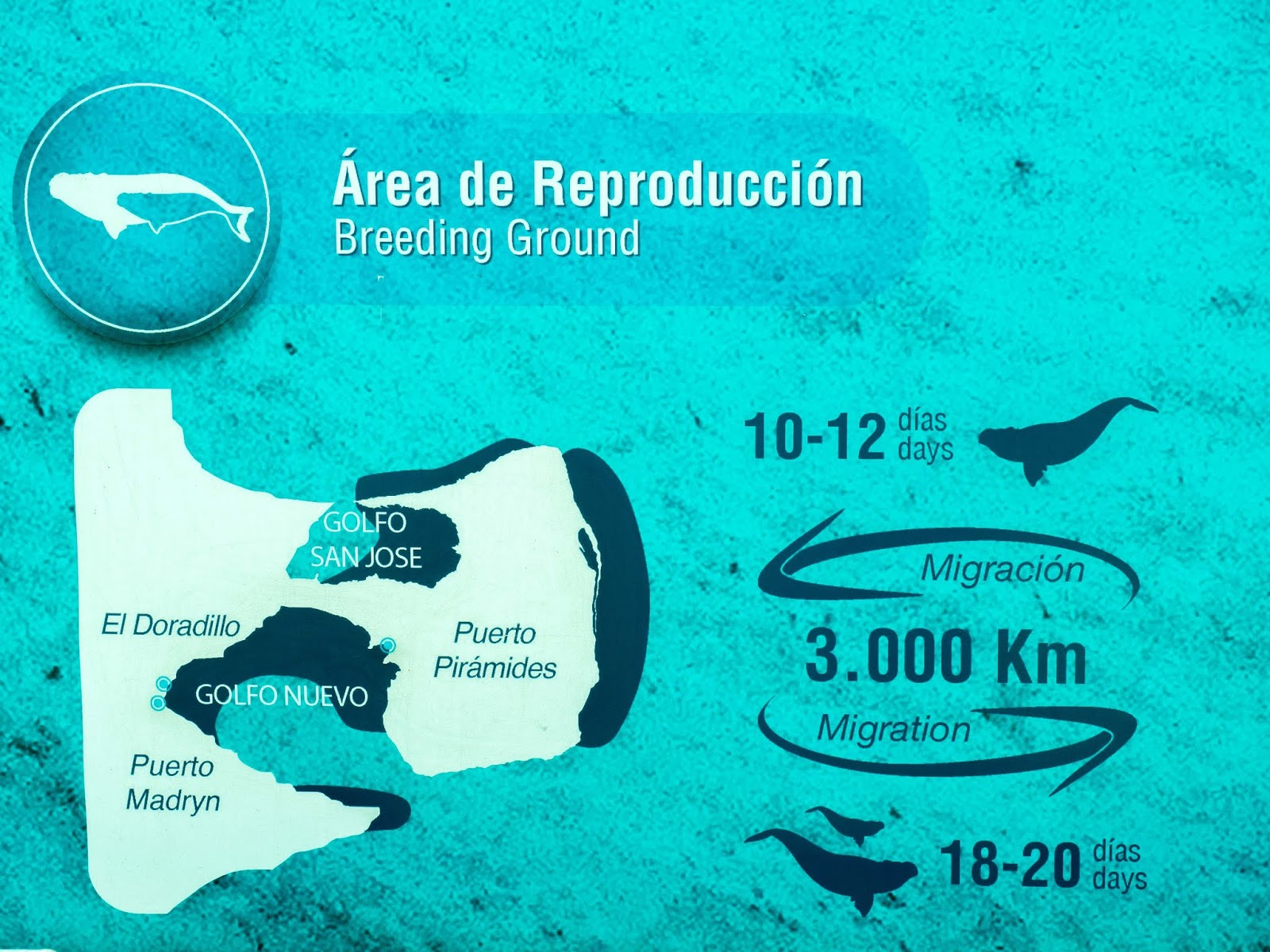

These horrifying numbers are the result of more than a century of whaling, now almost completely shut down.

I was a little surprised, and happy, to learn that all shipping traffic along the coast of Argentina must stay at least 50 miles from the coast, and reduce their speeds. This, to minimize danger and trauma to whales. Such rules now apply in most coastal countries.


World reduction in the whaling industry has reduced the harvesting of whales, their mortalities continue to  with whale/ship collisions, noise pollution, fish nets, toxins, and more.

While on the subject of preservation of species, I must say that Argentina is certainly doing its bit. In fact, The government flexes its muscles on the Argentine Sea. 

A small military type ship was berthed near our cruise ship. It was the coast guard, the Prefacto GC-28.

Argentina's coast guard is called the Prefectura or Prefecto. As with all national coast guard services, one of its major responsibilities is to protect its national waters from human piscivores, namely, poachers of its fish. 

The images painted on cutter's upper starboard bulkhead really caught my eye. (zoom in please) What is that fleet of 20 ships? What's with the mad gun-toting shark?
Prefecto Derbes GC-28 - Coast Guard cutter

I asked these questions of the local wharfinger. He had little English and I, little Spanish. We engaged in   a sort of pantomime to extract information and meaning but alas, all the gesticulations, grunting, ahh-ing and umm-ing, mouth breathing, and dancing about came to nought, except perhaps, some unexpected  entertainment for passers-by. 

After the last shrugging of shoulders I took some photographs. I did sense that the Argentinian was proud that I did.

This is what I learned when we got home:

The scary anchor-riding shark with the automatic rifle  is the coat of arms of this cutter. The crown of stars probably represents successful engagements with the shark's prey.

The boats on the wall are fish boats, most of them  Chinese. What they all have in common is that they were caught fishing in Argentine waters by the Prefacto GC-28 - not a good thing. In some cases the interlopers were scared off, escaping into international waters. Some, however, were not so lucky.

The pictures of the boats on the GC-28's bragging  wall represent engagements, or "kills" (by the nasty shark?), just like we used to see on the fuselage of WWll fighter planes.

The name of each ship and the date on interception is indicated.

Of particular note is the  LU YAN YUAN YU 010.

From Wikipedia: It was sunk on 15 March 2016 off the coast of Argentina by the Argentine Coast Guard during a territorial fishing dispute. There were no fatalities. According to trade sources, the ship had been involved in disputes over fishing rights before.
(There is more juicy information about the incident than this).


Don't mess with the Argentine Prefectura!


...ooo0ooo...


next blog post is: Ushuaia, Argentina


Monday, January 28, 2019

4. Punta del Este, Uruguay

Punta del Este, Uruguay


M/V Marina where we hung our hat for 20 days 
I took this photo from our tender to the wharf at Punta del Este. In post-processing I applied an effect called "surrealistic".

Why? Because it was.

Our tender (just kidding)
Our ship-to-shore tender

For some unknown reason, the ship sailed past Uruguay for our day in Buenos Aires, Argentina. The  next day we pointed north across the Rio de la Plata to Uruguay: Punta del Este, then on to Montevideo.

Punta del Este is Uruguay's seaside resort city. It attracts money, therefore, high-rise condominiums and pricey shoreside homes, marinas with expensive  yachts, good shopping and great restaurants. The year-round population of about 10,000 climbs to around 1/2 million during the summer season - end of Dec to early March.

Women's fashion store 
with an interesting name

We walked around, did some shopping, had a great seafood lunch, and of course, swam in the mild surf before catching the last tender back to the ship.


The bag I am carrying holds some really good local wine
This tiramisu was lighter than air!


The tannat grape was new to us. 

Originating in southwest France, this grape is now more common in Uruguay. It is their national grape.

This vino tinto was a very nice inexpensive tannat/merlot blend. It paired well with the osso bucco dinner that night at the Marina's Toscana Restaurant. The last glass was saved for a shared tiramisu. Wow!


Here is a map of our cruise showing the route from Rio de Janeiro to Santiago.
Large scale map of the voyage


This map jumps way ahead to when we sail through the Chilean fjords. The arrow designates our position on Day 17; the thin blue line marks the track taken; the red is the route to our destination. We are not there yet.


...ooo0ooo...


next post Montevideo

Montevideo. Plaza Independencia


www.noordinaryseaman.com for more photography and writing 


Friday, January 25, 2019

2. South to Buenos Aires


South to Buenos Aires

The sun dips below Corcovado Mountain taking today's temperature down to 30C. Humidity lingers at 50 percent. Passengers, excited about the cruise that lies ahead, are still sweating from the Brazilian heat wave. Are they ready for the mystery voyage: sharing 20 days with 1,000 strangers?


Captain Strazicic, our vessel's commander, is as cool as a cucumber as he directs his crew and the harbour personnel to separate us from the dock for an on-time departure.


dockside view


The photo above, which I tweaked a whole lot to bring up detail in the fading light, is busy and needs description:

The sun is setting behind the left shoulder of Jesus the redeemer. The hilltop housing (right centre) is the favela slum, juxtaposed with the high tech office building (left). Our ship is reflected in the lower left windows. Large indigenous Brazilian faces on a dockside warehouse - artwork commissioned for the 2016 Olympics - please the cruise-ship passengers, three of whom stand with their backs to the ship's rail. What are they looking at?


It is dark now. As we head through the harbour channel to the open sea another ship comes in to take our berth. Some passengers are dining below. Joanne is preparing for our late sitting, and I am out on deck capturing precious things with my camera. 


ships in the night


The lovely lady is alone with her thoughts.
I am drawn into the romance of the scene. 
The light is seriously gone. Should I or shouldn't I?  
I can't help myself. She is frozen in her own time, 
long enough for me to fiddle
with my camera settings.
I don't get her name.


red sky at night, sailors' delight


It was a hot night, and the first of many captivating sunsets to come.


On the way to Buenos Aires we stopped for a day at Ilha Grande, a semi-tropical island - no photos from there, then a day at Santos, port city, about 90 minutes by bus to São Paulo. We were advised by a friend who had been there that we may want to give São Paulo a miss.  We were not that keen on mingling with 17 million people in the third largest city in the world. 


The haze was unappealing


We chose instead  to stay on board that day, basking in the sun in the surreal world of service deluxe on deck 14.

We met some nice people who did one of the big pricy shore excursions and wished they hadn't. 


All the South American ports were shared by
cargo ships and cruise ships alike

The thing about cruise ships is that they often have to tie up to industrial docks. Any old sailor will tell you that the port is usually the worst part of a city - dirty, scuzzy, old worn down, and often dangerous.

But the grunge and the roughness is generally well-considered by our shipping line. Security is extreme, safety is assured. The to and fro of shore excursions are typically, nice coaches - cocoons on wheels, hosted by the informative patter of local guides.


 The port of Santos' population 
is almost half a million people


We happen to come from Vancouver, where the cruise ships berth in rather beautiful, if not, stunning surroundings.


TIP for viewing photos:
There is more in the photos than
can be displayed in this format.
Click on a photo to enlarge it then
return to the page by clicking on
the left arrow of your browser.


The next photos, I promise, are the worst images you will see in this blog. I was not going to use them, but the world is not all about beauty, and after all, I'm not doing an ad for cruising.

The left and right of this favela, this urban shanty town, is book-ended by deep-sea shipping docks for dry bulk freighters, huge container ships, & tankers.


There are 21 people in the water and on the shore,
from babies & toddlers, small children & teenagers
 to parents & grandparents.


As we look down from our $600 million dollar ship upon the favela, this is what they see - close and looming high above.


Us and them
 See the boy in shorts standing on the pile of rubble?


In all fairness, there are some nice things to see and do in Santos. Two shore excursions were titled, Highlights of Santos. But why would a hundred cruise ships a year park so close to these people? 

DISCLAIMER: being a cruise-ship-tourist-for-a-day in these places can surely be unfair for a city. Images of all kinds are a magnet for me and my camera. The editorializing is just me shooting from the lip.


Tonight we will be leaving Brazilian waters. It will be our last meal where we will have to pay a $25 (US) Brazilian surcharge on our table wine. What is the government doing with all that money?


GREETINGS FROM THE POPE 

in Buenos Aires
Pope Francis is from Buenos Aires, 
though this may not be his effigy 


We booked a Buenos Aires city tour online at home before we left. Our guide for this inexpensive excursion, Hernan, was everything you would want in a guide: punctual, friendly, educated and informative, a good sense of humour, accommodating (more on that, below).


I have captured some of  new city Buenos Aires and old city Buenos Aires.  Just like every other world centre, we see urban slum and decay mixed together with business towers of metal and glass. 


Clearly, BA is on the list of cities with impressive world class architectural and engineering landscapes. The juxtapositions of poverty and wealth, the spread of rich and poor, however, seems just a little a little more pronounced in South America than in North America and Europe. 


BA has a very European look and feel


Plaza de Mayo


The Metropolitan Cathedral overlooks Plaza de Mayo.


Mausoleum of national hero San Martin 
in the Metropolitan Cathedral
The Mausoleum in the church includes three life-size female statues that stand guard over the remains of Argentina's national hero, General Jose de San Martin who freed Argentina, Chile, and Peru from the Spanish Empire (circa 1818).


The Argentinian guards stood as wooden soldiers but they were very much alive. Close up I could see the perspiration on their faces. This guard nodded at me, very imperceptibly with maybe a millimetre of head and eye movement, just enough to advise me that I must remove my hat when entering the sacred chamber. He did that very graciously about three times while I was milling around, slack-jawed, marvelling at the space, until I finally realized that he was trying to communicate with me. I felt almost embarrassed.


Try that body language on someone: see how small a movement you can make to get them to do something. Don't move your eyebrows.


...oooOooo...


next post is More Buenos Aires


Joanne friending in the BANOS


www.noordinaryseaman.com for more photography and writing